
Are you a dependent of an Agrarian Reform Beneficiary (ARB) who dreams of pursuing a college degree in agriculture?
The DAR Scholarship Program for the Dependents of Agrarian Reform Beneficiaries (DSP-DARBs) offers financial support and free tertiary education opportunities in State Universities and Colleges (SUCs).
This scholarship program from the Department of Agrarian Reform aims to help students from agrarian reform families complete college and contribute to the development of the agricultural sector in the Philippines.
Continue reading below to learn about the eligibility requirements, benefits, required documents, and how to apply.
About DAR Scholarship Program
The DAR Scholarship Program for Dependents of Agrarian Reform Beneficiaries (DSP-DARBs) is designed to support the education of qualified dependents of registered Agrarian Reform Beneficiaries (ARBs).
The program focuses on courses related to agriculture and rural development. It aims to develop skilled professionals who can contribute to improving agricultural productivity, agribusiness, and sustainable farming practices in the country.
Scholars admitted to the program will receive financial assistance to help cover tuition fees, allowances, and other academic expenses throughout their studies.
Eligibility Requirements
To qualify for the DSP-DARBs Scholarship Program, applicants must meet the following criteria:
- Must be a legitimate dependent of an Agrarian Reform Beneficiary (ARB) such as a son/daughter, grandchild, nephew/niece, or under legal guardianship
- The combined annual family gross income must not exceed ₱100,000
- Must be a Senior High School graduate with a general average of at least 83%
- Must pass the entrance examination of the chosen State University or College (SUC)
- Must be physically fit and of good moral character
- Must have no criminal record or pending administrative/criminal cases
- Must not be a recipient of any other government scholarship or financial assistance program
Benefits
Qualified scholars under the DSP-DARBs program will receive the following financial assistance:
| Benefit | Details |
|---|---|
| School Fees | Up to ₱10,000 per semester paid directly to the SUC |
| Monthly Stipend | ₱3,000 per month during actual school attendance |
| Book Allowance | ₱2,000 per semester |
| Transportation & Lodging | ₱500 per month (may be converted to Internet allowance for online learning) |
| Thesis Allowance | ₱10,000 for graduating scholars |
| Graduation Fee | Up to ₱5,000 |
| Summer Class Support | Includes stipends, book allowance, lodging, and travel allowance if required by the curriculum |
Eligible Courses
Applicants must enroll in agriculture-related programs such as:
- BS in Agriculture
- BS in Agricultural Technology
- BS in Agricultural Entrepreneurship
- BS in Agricultural Education
- BS in Agricultural Chemistry
- BS in Agribusiness
- BS in Economics
- BS in Farming Systems
- BS in Homemaking
- Other courses directly related to agriculture
Document Requirements
Applicants must submit the following documents during application:
- Certification from DARRO/DARPO confirming that the applicant is a qualified ARB dependent
- Personal Data Sheet (CSC Form 212) or Bio-data
- Authenticated Birth Certificate
- Health Certificate issued by a government hospital or licensed physician
- Barangay Clearance
- Certified photocopy of Form 137 (High School Report Card)
- Statement of commitment and support from parents or guardian
- Certificate of Good Moral Character from the school principal or a religious leader in the community
- Certified True Copy of parents’ Income Tax Return (ITR)
- SUC Entrance Exam Rating and Certificate of Enrollment (if applicable)
- Duly accomplished scholarship application form
Application Period
The Department of Agrarian Reform has announced the opening of applications for the DSP-DARBs Scholarship Program.
The application period is from February 19 to March 19, 2026.
However, applicants are advised to coordinate with their local DAR Provincial Office for the exact submission deadlines and updates regarding the application process.
It is recommended to submit your requirements early to avoid delays in processing.
How to Apply
Follow these steps to apply for the DSP-DARBs Scholarship Program:
Step 1: Download the Application Form
Access and download the official application form here:
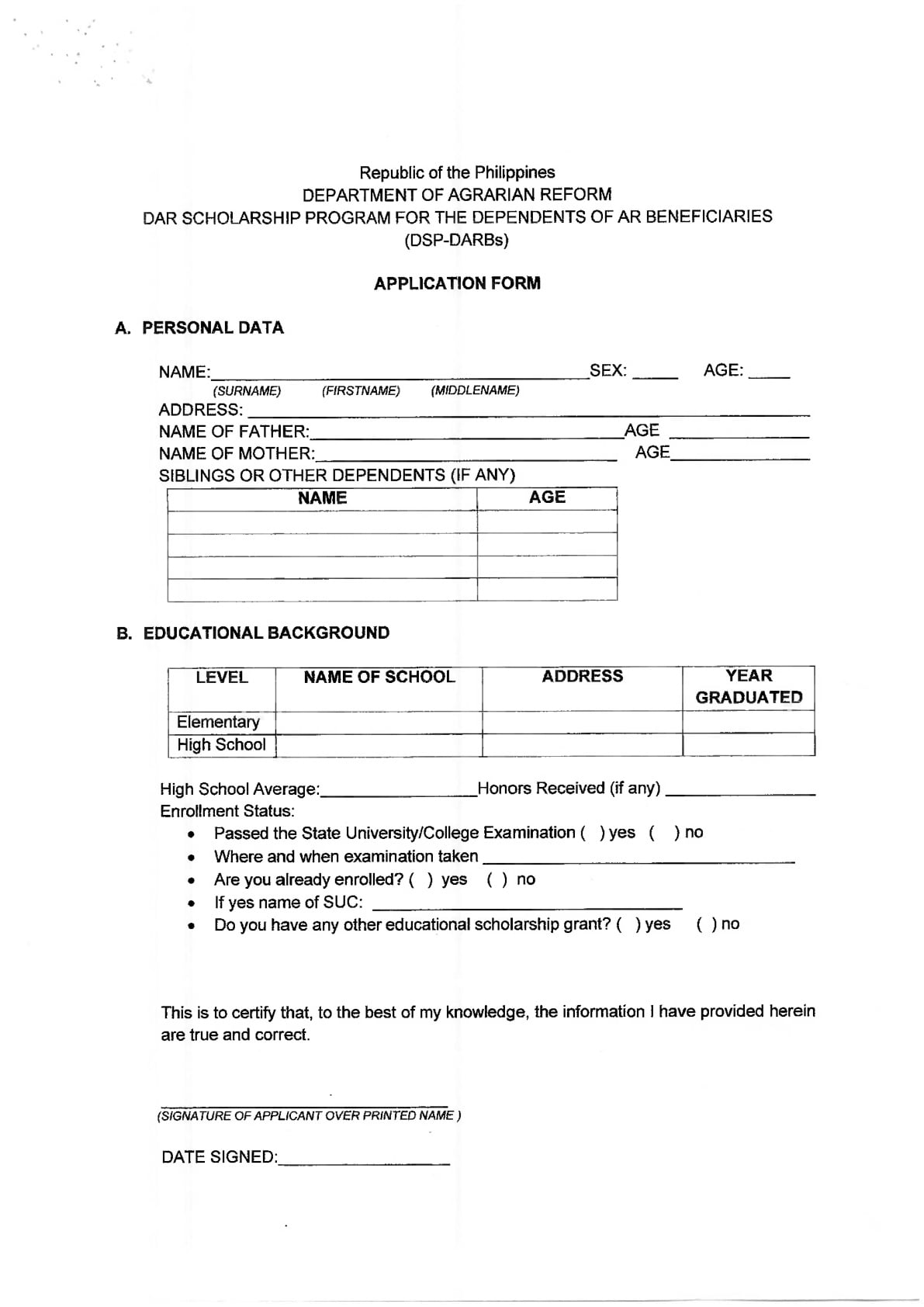
Step 2: Prepare All Required Documents
Gather and complete all documentary requirements listed above.
Step 3: Submit to Your DAR Provincial Office
Submit your completed application form and requirements to the Department of Agrarian Reform (DAR) Provincial Office in your area.
Step 4: Follow Local DAR Pages for Updates
For announcements and updates, follow your respective DAR provincial Facebook pages:
- DAR Regional Office CAR – facebook.com/DARCordilleraAdminRegion
- DAR Regional Office I – facebook.com/DARIlocosRegion
- DAR Regional Office II – facebook.com/DARRegion02
- DAR Regional Office III – facebook.com/DARCentralLuzon
- DAR Regional Office IV-A –
- DAR Regional Office IV-B – facebook.com/DARMIMAROPA
- DAR Regional Office V – facebook.com/DARProvincialOfficeAlbay
- DAR Regional Office VI – facebook.com/darregion6
- DAR Regional Office VII – facebook.com/profile.php?id=61553830403425
- DAR Regional Office VIII – facebook.com/darregion8
- DAR Regional Office IX – facebook.com/DARROIX
- DAR Regional Office X – facebook.com/JOYABREACHUA72
- DAR Regional Office XI – facebook.com/darregion11
- DAR Regional Office XII – facebook.com/DARSarangani
- DAR Regional Office CARAGA – facebook.com/DARCaraga
Step 5: Wait for Evaluation
Applications will be reviewed by DAR, and qualified applicants will be notified regarding the next steps.
Final Thoughts
The DAR Scholarship Program for Dependents of Agrarian Reform Beneficiaries (DSP-DARBs) provides an excellent opportunity for students from agrarian reform families to pursue higher education in agriculture.
By offering financial assistance and access to quality education in State Universities and Colleges, this program helps empower future agricultural professionals who can contribute to the country’s rural development.
If you are eligible, take the time to prepare your documents and submit your application through your local DAR office. Opportunities like this can help turn your academic and career goals into reality.
Know someone who might benefit from this scholarship? Share this information with them so they can apply and take advantage of this opportunity.
References
- Department of Agrarian Reform. (n.d.). DAR Scholarship Program for the Dependents of Agrarian Reform Beneficiaries (DSP-DARBs). Retrieved from official DAR announcement materials and regional DAR Facebook pages. https://www.facebook.com/story.

Leave a Reply