
Pursuing college can be financially challenging, but numerous government, private, and institutional scholarships can help cover tuition, stipends, books, and living expenses.
For the 2026-2027 academic year, major programs like CHED, DOST-SEI, TES, and private foundations are key opportunities.
Table of Contents
How to Apply for Scholarships in the Philippines
This guide will walk you through the full process of how to apply for scholarship in Philippines for 2026. From planning your grades and documents to submitting online applications and preparing for interviews.
Step 1: Understand the Types of Scholarships in the Philippines
Before applying, it helps to know the main categories of scholarships you will encounter in 2026.
Government Scholarships (Most Accessible and Generous):
- CHED Merit Scholarship Program (CMSP): Merit-based for high-achieving students (GWA 93-95% for half merit, 96%+ for full). Covers tuition, fees, books, and stipend. Priority for underprivileged groups, PWDs, solo parent dependents, etc. Enroll in CHED priority courses.
- DOST-SEI Undergraduate Scholarships: For STEM courses. Includes tuition (up to ₱40,000/year), monthly stipend (around ₱7,000-8,000), books, etc. Requires passing an exam.
- Tertiary Education Subsidy (TES): Need-based through UniFAST. Provides ₱40,000 (SUCs/LUCs) to ₱60,000 (private HEIs) per year. Prioritizes 4Ps beneficiaries and low-income students.
- Tulong Dunong Scholarship: ₱15,000/year for tuition in eligible institutions.
- OWWA Scholarships (for OFW dependents): EDSP, ODSP, etc., with varying amounts.
- Others: BARMM, provincial scholarships, GSIS, etc.
School or University Scholarships
- Ateneo, DLSU, UST, and others offer merit, need-based, athletic, and arts scholarships.
Non-Profit & Foundation Scholarships
- SM Foundation, Ayala, Aboitiz, Megaworld, LANDBANK, etc. Often include tuition, allowance, and work opportunities.
Corporate or Company Scholarships
- Panasonic, SN Aboitiz Power Group BRIGHTS, DBP INSPIRE, Deltek Systems (Philippines) Ltd. and etc.
Community-Based Scholarships
- Negros Occidental Scholarship Program, Sta. Lucia Scholarship Program, Makati City Revitalized Scholarship Program and etc.
International Scholarships
- Japanese Government (MEXT), Fulbright, etc., for studying abroad.
Each scholarship has its own eligibility rules (GWA cut-off, income brackets, priority courses, etc.), so your first task is to know which type fits your situation.
Step 2: Check Your Eligibility Early
Most major scholarship programs in the Philippines have common eligibility criteria:
1. Citizenship
- You must be a Filipino citizen, usually proven with a PSA birth certificate.
2. Academic performance
- High GWA (often 85-96%+ depending on program), no failing grades.
3. Financial need
- Many scholarships prioritize low-income or indigent families. They usually ask for parents’ Income Tax Return, Certificate of Tax Exemption, Certificate of Indigency, or similar proof.
4. Special groups (if applicable)
- Some programs have slots or priority for PWDs, solo parents and their children, indigenous peoples, senior citizens’ dependents, and homeless or underprivileged citizens, verified through government-issued IDs or certification.
Checking these criteria as early as Grade 11 or early in Grade 12 helps you know if you need to improve your grades, prepare documents, or look for more suitable programs.
Step 3: List and Organize Scholarship Opportunities for 2026
Instead of applying randomly, build an organized list.
1. Use scholarship listing sites and media
- Platforms and sites dedicated to Philippine scholarships compile government and private programs and give quick overviews of requirements, benefits, and deadlines.
2. Track government programs
- CHED Merit Scholarship (for incoming first-year college students) often opens applications once CHED issues announcements.
- PCSO Educational Assistance for 2026 now uses eGovPH and sometimes email for applications.
- DOST scholarship announcements and guides appear on official sites and social media.
Many scholarship coaches now recommend using a planner or checklist so you can track application windows, status, and required documents in one place.
- You can:
- Use a notebook, planner, or spreadsheet on your phone or laptop.
- Create columns like:
- Scholarship name
- Requirements
- Deadline
- Status (Not started / In progress / Submitted)
Then, add the scholarships you want to apply for.
After that, write the deadlines in your calendar or planner. You can set reminders on your phone so you don’t forget.
This helps you see what you must do this week, this month, and before graduation.
Step 4: Prepare Your Documents in Advance
Incomplete or unclear documents are a common reason for rejection or delay. Prepare them before the application periods open.
You will feel less stressed if your documents are ready before the application starts.
Most scholarships ask you for:
Your personal documents
- Birth certificate
- Recent ID photos
- Any valid ID you already have
Your school documents
- Report card if you are in SHS
- Grades or TOR if you are already in college
- Certificate of enrollment or admission if they ask for it
Your family income documents
- Your parents’ or guardian’s ITR, or
- Certificate of tax exemption, or
- Certificate of indigency from your barangay or DSWD
Other documents (only if they apply to you)
- PWD ID
- Solo parent ID
- Certificate for IP communities
- Other special IDs or certifications
Put all of these in one physical folder.
For online applications, you also need digital copies. You can scan them or take clear photos (no glare, no cut parts, all text readable). Keep them organized in one folder on your phone or laptop.
Step 5: Research and Create a Timeline (2026 Key Dates)
Deadlines vary and are often announced months ahead:
- CHED: Typically May–July (check for 2026 updates).
- DOST-SEI: Applications often open around August–October (exam follows).
- TES/Tulong Dunong: Ongoing or per semester via UniFAST.
- Private/University: Vary (e.g., December for some Ateneo 2026-2027 apps; SM, others in early year).
- OWWA and others: Check specific portals.
Action Plan:
- January–March: Research, prepare docs, take entrance exams.
- April–July: Apply to government scholarships.
- Monitor official sites, Facebook pages (CHEDROs, DOST-SEI), and scholarship aggregators like BuildNation.ph.
Step 6: Get Familiarize with the Step-by-Step Application Process
General Steps (Adapt per Program):
- Research & Shortlist: Visit official websites (ched.gov.ph, sei.dost.gov.ph, university sites). Make sure you are on the official website or official page of the scholarship. Avoid random links from unknown pages.
- Confirm Eligibility & Prepare Docs: As above.
- Read the instructions carefully: Don’t skip. Read everything from requirements, to steps, to deadlines.
- Apply Online:
- CHED: Submit to your CHED Regional Office (CHEDRO) portal based on residence/point of origin. Create account, fill form, upload docs.
- DOST-SEI: Via science-scholarships.ph or ugs.science-scholarships.ph. Register, fill form, upload, select test center.
- TES: Through your school/UniFAST.
- Private: Company/foundation portals or email/submission forms.
- University: Often tied to admission application; submit scholarship form separately with recommendations.
- Take Exams/Interviews (If Required):
- DOST: Scholarship exam.
- Universities: Entrance tests + possible interviews.
- Some privates: Interviews or essays.
- Submit & Follow Up — Avoid last-day submissions due to portal traffic. Keep application references.
- Await Results — Notifications via email or portals. Prepare for contract signing/orientation if awarded.
- Enroll & Maintain Scholarship — Maintain grades, enroll in required courses, submit reports as needed. Many require no other scholarships or service obligations post-graduation.
Step 7: Maintain Your Scholarship Once You Get It
When you finally become a scholar, you need to keep your scholarship active.
Most scholarships require you to:
- Maintain a certain grade or GWA.
- Avoid failing major subjects.
- Follow school and scholarship rules properly.
You can do this by:
- Tracking your grades every term.
- Asking your teachers or classmates for help when you are struggling.
- Managing your time well between school, home, and other responsibilities.
Remember, you worked hard to get the scholarship. You also need to take care of it.
Tips to Increase Your Chances in 2026
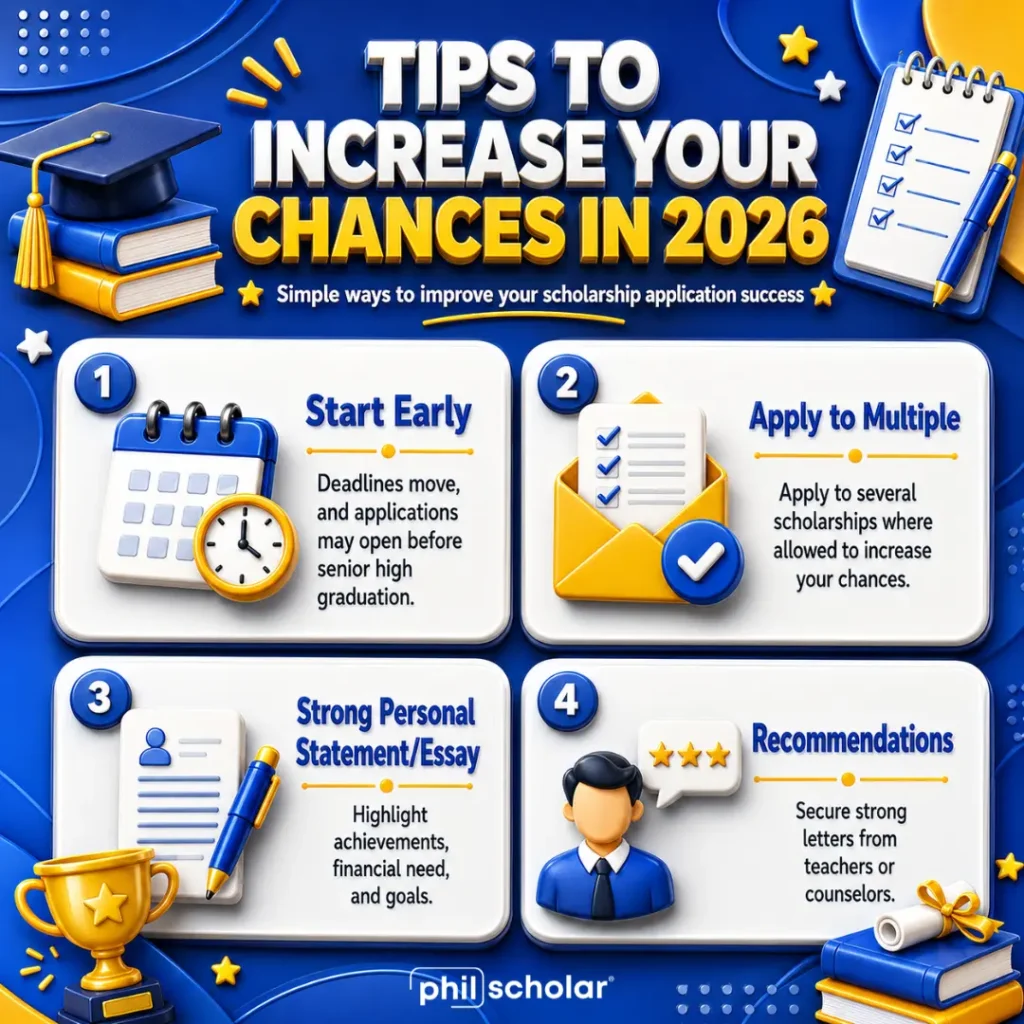

With early preparation, organized applications, and a clear story about your goals and financial need, you can significantly improve your chances of becoming a scholar in the Philippines for 2026.
Quick Guide: 5 Things You Need to Do
- List the scholarships you want to apply for.
- Check if you are qualified for each one.
- Prepare your documents early.
- Submit your application correctly and on time.
- Watch for results, follow-ups, and possible scams.
You can read this full guide now, save it for later, and share it with your classmates who also want to become scholars.
Disclaimer
This guide is for general informational purposes only. Application requirements, processes, and qualifications may vary per scholarship program. For the most accurate and updated details, always refer to the official announcements or websites of the concerned government offices.
Final Thoughts
Applying for a scholarship in the Philippines can feel confusing at first, but you now have a clear path you can follow.
You already know the different types of scholarships, how to check if you qualify, what documents you need, and how the step-by-step application process works.
Use this guide as your starting point. Save it, come back to it when deadlines are near, and share it with your classmates who also dream of finishing college.
Your scholarship journey is not just about money; it is about opening doors to opportunities for you and your family.
Reference
- Commission on Higher Education. (2026). CHED Merit Scholarship Program. [online] Available at: https://legacy.ched.gov.ph/merit-scholarship/ [Accessed 14 May 2026].

Leave a Reply